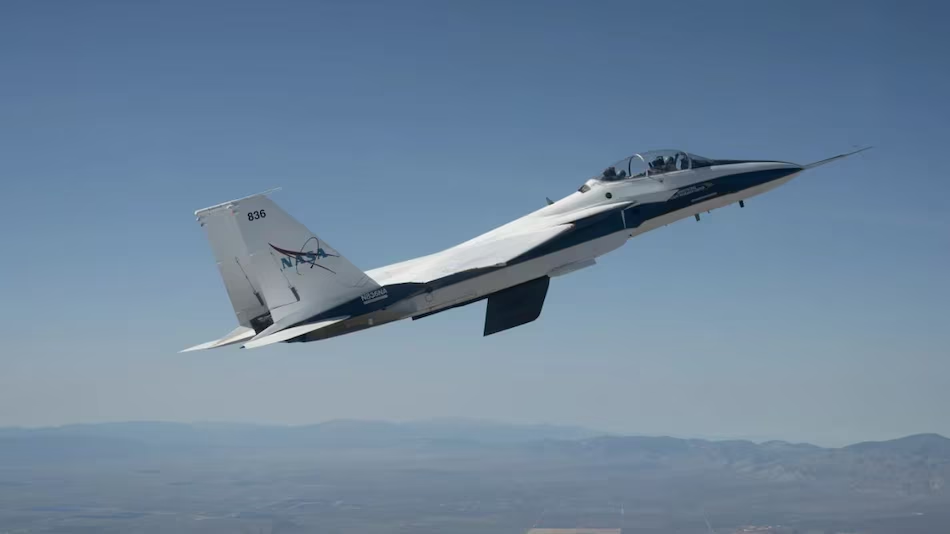
NASA successfully tests its CATNLF laminar-flow wing on an F-15B jet, aiming to reduce aircraft drag and improve fuel efficiency by up to 10%.
NASA Achieves Breakthrough in Drag-Reducing Laminar-Flow Wing Technology
In a major milestone for aerospace engineering and next-generation aircraft efficiency, NASA has successfully conducted the first flight test of its Crossflow Attenuated Natural Laminar Flow (CATNLF) wing model aboard a modified F-15B research jet. The test is a pivotal step toward validating a technology designed to significantly reduce aerodynamic drag and cut fuel consumption in future commercial and military aircraft.
This article covers the full scope of the NASA laminar-flow wing effort, the science behind it, its implications for commercial aviation, and how this technology could shape the future of efficient flight.
What Is Laminar Flow and Why It Matters
Aerodynamic drag is one of the biggest forces working against aircraft performance. As air flows over a wing, it transitions from smooth, orderly movement — known as laminar flow — to chaotic and energy-losing turbulence. Turbulent airflow increases drag, reduces fuel efficiency, and limits the overall performance of the plane.
NASA’s CATNLF concept focuses on extending the laminar flow region over wing surfaces. By keeping air flowing smoothly over more of the wing for longer distances before transitioning to turbulence, drag is reduced significantly. Early computational studies conducted by NASA suggested that applying this laminar-flow technology to a large commercial aircraft could cut fuel burn by up to 10%, potentially saving airlines millions in annual fuel costs.
The First CATNLF Flight Test
On January 29, 2026, NASA’s Armstrong Flight Research Center in Edwards, California conducted the first flight of the CATNLF test article attached to an F-15B research jet.
Key Details
-
Aircraft Used: Modified NASA F-15B research jet
-
Test Article: 40-inch scale CATNLF wing model
-
Mounting Position: Vertically beneath the aircraft like a fin
-
Flight Duration: Approximately 75 minutes
-
Test Objectives: Verify safe flight handling with the model installed and collect aerodynamic data
During the flight, pilots performed standard flight maneuvers — including turns, steady holds, and gentle pitch changes — across altitudes ranging from about 20,000 to nearly 34,000 feet. These tests confirmed that the wing model did not interfere with normal flight handling and that the fundamental airflow behavior closely matched predictions from earlier computer models.
Michelle Banchy, the research principal investigator for CATNLF, stated that seeing the model fly validated years of design and preparation work and marked a key milestone for the project.
This first flight is just the beginning of up to 15 planned flights that will span multiple speeds, altitudes, and conditions as NASA works to fully characterize the technology’s performance in real flight conditions.
How CATNLF Works: The Science Explained
The CATNLF innovation isn’t just another wing shape. It is specifically designed to control the airflow “boundary layer” — the thin layer of air that directly contacts the surface of the wing.
NASA researchers have pursued a new crossflow suppression technique that reshapes wing airfoils in such a way that:
-
It reduces disturbances in the boundary layer
-
Helps delay the transition from laminar to turbulent flow
-
Delivers smoother airflow over more of the wing surface
This technique is especially important for swept-wing designs, which are common in commercial airliners. Swept wings improve stability and speed but also tend to trigger earlier transition to turbulence due to crossflow instabilities. CATNLF’s specific surface geometry works to control those instabilities.
Fuel Efficiency and Industry Impact
One of the greatest long-term benefits of maintaining laminar flow is reduced fuel consumption. Drag forces increase the amount of thrust needed to maintain cruise speed, so reducing drag directly translates to lower fuel burn.
NASA computational studies conducted over several years estimate that integrating CATNLF technology into the wing design of a long-range airliner — such as a Boeing 777 class aircraft — could reduce fuel consumption by as much as 10% annually. Over the lifespan of an airliner, that equates to millions of dollars in savings per aircraft and commensurate reductions in carbon emissions.
This makes CATNLF one of the most promising aerodynamic innovations in decades and potentially a game changer for both commercial and military aviation efficiency.
What Comes Next
The F-15B flight tests represent the start of a broader validation campaign. NASA plans to:
-
Conduct multiple additional flights across a range of flight conditions
-
Collect detailed data for aerodynamic modeling and certification
-
Explore how CATNLF can be scaled and integrated into full-size aircraft designs
Future research could also expand the concept to other aircraft components beyond wings, such as tails or control surfaces, and explore potential applications for supersonic or military platforms.
Laminar Flow — A Legacy of Aeronautical Innovation
Laminar flow concepts are not new; NASA and its predecessor organizations have explored boundary-layer control for decades. Past programs like the Northrop X-21A laminar flow control project and earlier F-16XL experimental flights helped establish foundational knowledge in this field. Today’s CATNLF effort builds directly on that legacy but applies modern computational tools, materials, and test facilities to achieve what earlier projects could only model.
Conclusion
NASA’s successful flight test of the CATNLF laminar-flow wing model aboard the F-15B represents a major aviation technology breakthrough. By enabling smoother airflow and significant drag reduction, this technology holds the promise of up to double-digit fuel efficiency gains for future airliners.
As global aviation continues its push toward sustainability and cost efficiency, innovations like CATNLF are critical components of the next generation of aircraft design.
FAQs
1. What is NASA’s laminar flow wing technology?
NASA’s laminar flow wing technology, known as CATNLF, is an advanced aerodynamic design that reduces drag by maintaining smoother airflow over aircraft wings for longer distances.
2. How does laminar flow reduce aircraft drag?
Laminar flow minimizes turbulence on the wing surface, which lowers aerodynamic resistance. Reduced drag means engines require less thrust, improving fuel efficiency.
3. What aircraft was used in NASA’s wing test?
NASA tested the CATNLF wing model on a modified F-15B research jet operated by NASA’s Armstrong Flight Research Center.
4. How much fuel can this technology save?
NASA studies suggest laminar-flow wing integration could reduce fuel burn by up to 10% on long-range commercial aircraft.
5. Why is this breakthrough important for aviation?
The technology could lower airline operating costs, reduce carbon emissions, and support sustainable aviation goals worldwide.
Disclaimer: This article is based on publicly available research updates and official aerospace testing reports. Performance projections are subject to further validation and real-world integration studies.